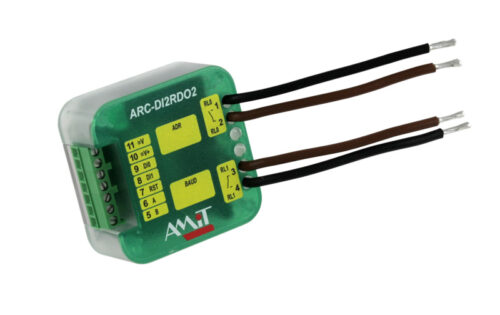
ARC-DI2RDO2: flush-mounted module for controlling lights and blinds
We are adding the new ARC-DI2RDO2 flush-mounted module to the AMiT Automation portfolio designed primarily for controlling lights or blinds. The module is also suitable for applications where it is necessary to respond to other operational conditions in the room such as a window contact, presence detection or other signals.
Thanks to its compact dimensions the ARC-DI2RDO2 is suitable for installation in a KU68 flush-mounted box where it remains hidden and does not detract from the interior’s appearance.
The module is equipped with two digital inputs and two relay outputs. It enables easy connection of local control elements such as push-buttons, switches or contacts, to relay outputs for lighting, shading or other technologies in the room.
The module is provided as a single-purpose solution, which can be configured via parameters using the RS485 interface and the MODBUS RTU protocol. This makes it easy to adapt to a specific application without the need to write a user programme.
Key features
- 2× relay outputs
- 2× digital inputs
- RS485 interface with MODBUS RTU protocol
- configurable input and output behaviour
- stand-alone operation without a master system
- control from a master system
- combined local and remote control
- installation in a KU68 junction box
- 24 V DC/AC power supply
- suitable for controlling lights and blinds, or for expanding the system with additional inputs/outputs
Stand-alone, via the BMS or a combination of both
The ARC-DI2RDO2 can operate fully autonomously with the outputs responding directly to digital inputs. It can also be controlled from a supervisory system via MODBUS RTU. In combined mode it is possible to link local control with control from the BMS, thereby maintaining both the convenience of in-room control and the option of centralised management.
The ARC-DI2RDO2 provides a simple way to add local switching functions to building automation, while maintaining the option of manual control and ensuring the device remains under the supervision of a supervisory system.