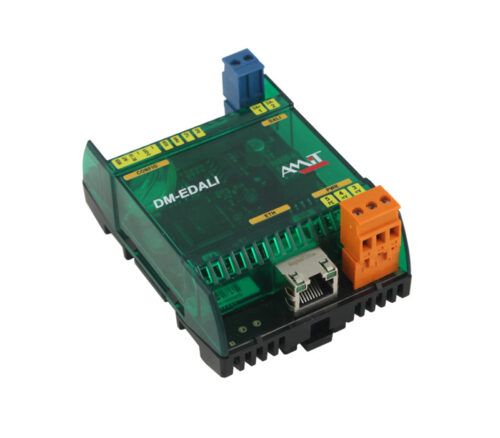
DM-EDALI for integrating DALI lighting not only into BMS
The DM-EDALI is a MODBUS TCP/DALI communication converter that enables DALI lighting to be connected not only to building measurement and control systems. Via Ethernet it provides direct control of devices on the DALI bus as well as their configuration and basic diagnostics..
The converter operates on the DALI bus as a multi-master and also serves as a power supply for the DALI bus. This allows up to 64 DALI peripherals to be connected to a single bus without the need for a separate power supply for the DALI bus.
Easy configuration via a web interface
The DM-EDALI is equipped with an integrated web interface that simplifies commissioning and maintenance. Via the web you can set network parameters, address ballasts, configure their behaviour, work with scenes and groups or directly control individual devices on the DALI bus..
This will be particularly appreciated by system integrators during the commissioning and later management of lighting in buildings.
Key features
- MODBUS TCP/DALI converter – not just for BMS systems
- DALI interface in multi-master mode
- Internal power supply for the DALI bus
- Connection of up to 64 devices on a single DALI bus
- Configuration and control via a web interface
- Direct control of peripherals, groups and the entire bus
- Configuration of scenes, groups and ballast parameters
- Converter power supply: 24 V AC/DC or PoE
- DIN rail mounting
- Clear LED status and communication indicators
For BMS integrators and designers
DM-EDALI enables lighting technology to be integrated into a building’s measurement and control system. This means that lighting does not have to be managed as a separate technology – isolated from other systems. It can become part of a single interconnected structure.
For system integrators this means an implementation that allows lighting, heating, cooling, ventilation and other building technologies to operate as a single (interconnected) system. Instead of separate systems the investor obtains a solution offering a better overview of operations greater scope for optimisation and more efficient energy consumption management. At the same time the integration of these technologies simplifies management and maintenance and helps to reduce the operating costs of the building as a unit.